
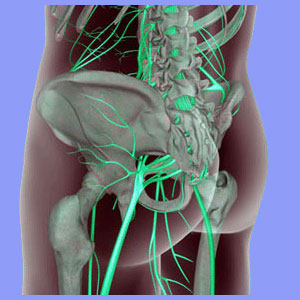
The sciatic nerve, less commonly known as the ischiatic nerve, is the largest and thickest nerve in the human body. There are bilateral branches of this nerve, which begin as spinal nerve roots in the lower back and combine to form a single nerve, before branching out again into various peripheral nerves which serve the neurological requirements of each lower limb. Most patients have pain which occurs in only one leg or foot. This is called unilateral sciatica and accounts for the vast majority of complaints. However, some patients may have symptoms in both branches of the sciatic, enacting bilateral and doubly debilitating sciatica.
This article section will provide anatomical facts about this largest of human nerves, as well as debunk the myths of suffering from a pinched sciatic nerve.
Sciatic Nerve Anatomy
The sciatic is a thick and complex nerve structure which is formed by the joining of the L4, L5, S1, S2 and S3 spinal nerve roots. The sciatic does not touch the spinal cord or cauda equina directly, but instead is formed by branches of exiting spinal nerves. This is why it is impossible to have a spinal structure cause pain by pinching the sciatic directly. However, the sciatic can be pinched by soft tissue conditions, such as piriformis syndrome, after it is fully formed in the lower anatomy. Once joined, these 5 nerve roots make up the biggest nerve in the human body. This nerve eventually branches into several other smaller nerves which serve individual areas of the legs and feet.
The neurological impulses which travel the sciatic are responsible for facilitating motor function in the muscles of the lower limbs.

Nerve messages which control movement originate in the brain and are sent to receptors in the legs to contract specific muscles.
Neurological messages providing sensory perception also travel on the sciatic. These sensory impulses originate in the lower limbs and go to the brain, where they are interpreted and registered as any of the feelings or sensations we can experience in the skin or underlying tissues, including sciatica pain.
Ischiatic Nerve Problems
There are three major concerns involving the sciatic which are thought to create the many common pain scenarios referred to as sciatica and pseudo-sciatica:
The most common medical explanation for sciatica pain is compression of a spinal nerve root, also called a pinched nerve, prior to it joining with other nerve roots to form the sciatic main nerve in the lower pelvis.
Any of the 5 spinal roots in the lumbar or sacral spinal regions can be targeted for compression by any number of causes. The most commonly affected are certainly the L4, L5 and S1 nerve roots.
Piriformis pain syndrome is the name of the condition thought to cause pseudo-sciatica as the main nerve exits the greater sciatic foramen. This condition exists when the piriformis muscle constricts the sciatic as it leaves the pelvis.
Ischemia is the medical term for simple oxygen deprivation, which is a common cause of a wide range of back and leg pain conditions. Nerve tissue, such as that in the sciatic, is highly susceptible to oxygen deprivation and can be significantly affected at even the lowest levels of regional ischemia. This scenario can be created by structural or disease processes, but is far more often the direct result of a psychosomatic sciatica causation.
Less common problems which might affect the sciatic or its peripheral branches may include diabetic neuropathy and various other types of neuralgias, localized nerve injury and neuromuscular diseases.
Do you suspect that you are suffering from a pinched sciatic nerve?

Sciatic Nerve Factsheet
This nerve has been targeted as one of the most implicated of all structural scapegoats for a variety of dorsopathy conditions. While it is often involved in the many lower body pain syndromes, the actual reasons for the symptoms are commonly misdiagnosed. This is the reason why so many sciatica conditions do not respond well to a barrage of seemingly appropriate treatment options. Of course these therapies will not work well, since they are not targeting the actual source of pain.
If you have been diagnosed with a radicular nerve pain syndrome, you owe it to yourself to understand to real facts about sciatica. Once you can appreciate what does not typically cause nerve related pain, it will be far easier to identify the real source of your disconcerting symptoms.